

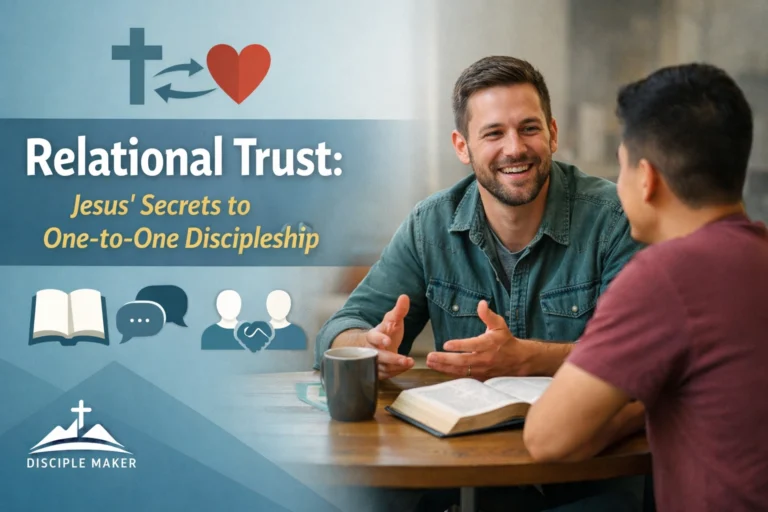
Let’s be honest for a second: most of us feel a little bit intimidated when we hear the word "discipleship." We immediately start thinking about heavy theology books, Greek lexicons, and the fear that someone might ask us a question we can’t answer. We think we need a seminary degree just to sit down with a friend and talk about God.
But here’s the secret: Jesus didn’t run a classroom. He didn’t hand out syllabi or give mid-term exams. He built relationships. He moved at the speed of trust.
If you want to know what is discipleship, you don’t have to look much further than the way Jesus interacted with the people right in front of Him. He focused on one-to-one moments and small-group intimacy, and at the heart of it all was something we call "Relational Trust."
The Foundation: Trust Over Programs
We live in a world that loves "scales" and "systems." We want to reach the masses, and we want to do it fast. But Jesus’ strategy was radically different. He poured the majority of His time into a few people. Why? Because you can’t build deep, life-altering trust with a crowd. You build it over a meal, during a long walk, or while fishing on a boat.
In John 15:15, Jesus says something revolutionary to His disciples: "No longer do I call you servants… but I have called you friends."
Think about that. The Creator of the Universe chose to call these messy, flawed human beings His friends. That shift from "servant" to "friend" is the cornerstone of relational trust. Discipleship isn't a boss-employee relationship; it’s a friendship with a purpose. It’s about walking together toward the heart of God.
Secret #1: Proximity is the Greatest Teacher
Jesus didn't just meet the disciples for an hour on Sunday mornings. He lived with them. He was present.

In our busy, 2026 lives, we often try to squeeze discipleship into the margins. We think a 30-minute coffee once a month is enough. But Jesus showed us that trust is built in the "along the way" moments.
When you’re looking to mentor someone, don't just invite them to a Bible study; invite them into your life. Let them see how you handle a stressful work call. Let them see how you treat the waiter when your order is wrong. Let them see your prayer life when things are tough. Proximity creates the space where trust can actually grow because it moves from "theory" to "reality."
Secret #2: The Power of Vulnerable Leadership
If you want someone to be open with you, you have to be open with them. This is where a lot of mentors get stuck. We feel like we have to project a "perfect" Christian image. We think, "If they knew I still struggle with anxiety (or anger, or doubt), they wouldn’t listen to me."
But look at Jesus in the Garden of Gethsemane (Matthew 26:36-46). He didn’t hide His agony from His closest friends. He told them, "My soul is very sorrowful, even to death." He invited Peter, James, and John into His moment of greatest vulnerability.
When we are honest about our own journey: our wins and our messy failures: it gives the person we are discipling "permission" to be honest too. Trust isn't built on your perfection; it’s built on your authenticity.
If you’re wondering how to get started with this kind of raw honesty, check out our guide on how to disciple someone. It breaks down the practical steps to building that initial bridge of trust.
Secret #3: Listening is Better Than Lecturing
Have you ever noticed how many questions Jesus asked? Even though He literally had all the answers, He constantly used questions to draw people out.
Take the walk to Emmaus in Luke 24. Jesus joins two disciples who are discouraged and confused. He could have started with a three-point sermon immediately. Instead, He asks, "What is this conversation that you are holding with each other as you walk?" He let them talk. He listened to their grief and their confusion before He opened the Scriptures to them.
One-to-one discipleship thrives when the mentor listens more than they talk. When you listen, you’re telling the other person, "You matter. Your thoughts matter. Your struggles are worth my time." That is how you earn the right to be heard.

Secret #4: High Support, High Challenge
Jesus had an incredible way of being incredibly kind while also being incredibly challenging. He didn’t let people stay where they were, but He never abandoned them when they tripped.
Think about Peter. Peter was the guy who constantly stuck his foot in his mouth. He even denied Jesus three times! If Jesus were running a modern corporate leadership program, Peter probably would have been "let go" after the first season.
But Jesus didn't give up on the relationship. After the resurrection, Jesus met Peter on the beach, cooked him breakfast, and restored him (John 21). He gave Peter "High Support" by feeding him and loving him, and "High Challenge" by telling him, "Feed my sheep."
Relational trust means your disciple knows that even if they fail, you aren't going anywhere. You are in it for the long haul.
Secret #5: It’s All About Jesus (Not You)
The biggest "secret" to Jesus-centered discipleship is remembering that you aren't the hero of the story: Jesus is.
Our job isn't to make people more like us. Our job is to walk with them as they become more like Him. When we keep the focus on Jesus: His words, His grace, His life: the pressure falls off our shoulders. We don't have to have all the answers because we know the One who does.
At Disciple Maker, we’re passionate about using technology to facilitate these real-world connections. We believe tools should help you stay organized so you can focus on the person sitting across from you. If you want to see how we’re helping people keep their discipleship journey on track, you can learn more about our app.
Making it Practical: How to Start This Week
You don't need a formal program to start building relational trust. You just need a willing heart and a little bit of intentionality. Here are three simple ways to "Jesus-ify" your one-to-one discipleship this week:
- The "Third Space" Meetup: Instead of a formal meeting, invite them to something you’re already doing. Going to the gym? Need to run to the hardware store? Invite them along. The "non-spiritual" moments are often where the best spiritual conversations happen.
- The "No-Fix" Zone: Next time they share a struggle, try not to give advice for at least ten minutes. Just listen and ask, "Tell me more about that." See how much deeper the trust goes when they feel heard rather than "fixed."
- Pray Specifically: Don't just say, "I'll pray for you." Stop right there and pray for the thing they just shared. It shows that you value their heart in real-time.

No Seminary Degree Required
The beautiful truth is that Jesus chose fishermen, tax collectors, and everyday people to change the world. He didn't look for the most educated; He looked for the most available.
If you love Jesus and you care about people, you are qualified to disciple someone. You are qualified to build a relationship based on trust, grace, and the Gospel.
If you’re feeling a nudge to start but aren’t sure where the road leads, take a look at our features to see how we can support your journey. Whether you’re a church leader or just someone who wants to help a friend grow, the Jesus model is the only one that truly transforms lives.
Let’s stop overcomplicating it. Let’s start eating together, praying together, and walking together. Let’s build some relational trust and see what Jesus does with it.
Ready to dive deeper? Check out our other posts on the Disciple Maker blog for more tips on living out the Great Commission in your daily life.
Go get 'em! The world needs more people who are willing to walk the way Jesus walked.